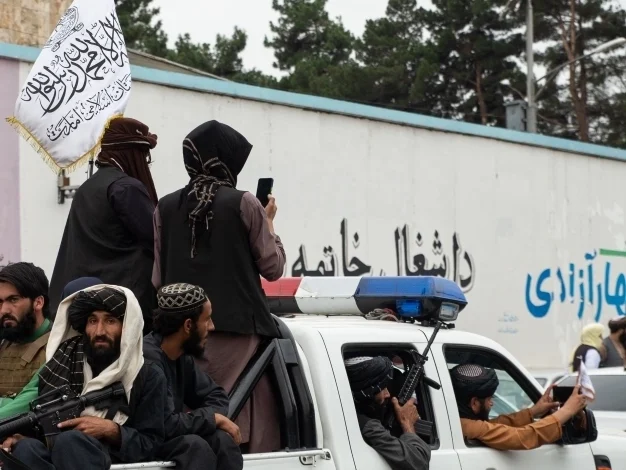
The Taliban, the ruling political and militant group in Afghanistan, announced Wednesday an internet ban across a significant portion of northern Afghanistan. Provincial governments cited the prevention of “immoral activities” as the justification for the measure.
The move aligns with the group’s previously expressed concerns regarding online pornography and perceived inappropriate interactions between men and women online.
This marks the first region-wide internet ban since the Taliban seized control of Afghanistan in 2021. Other restrictions previously implemented by the Taliban include barring girls from attending high school and preventing women from working in numerous sectors.
The ban will affect five provinces – Kunduz, Badakhshan, Baghlan, Takhar, and Balkh – in the northern part of the country, encompassing the region’s major population centers.
Officials stated that the restriction specifically targets internet connections provided via fiber optic cable. Mobile phone data access will remain available.
A statement from the affected provinces confirmed that all fiber optic connections have been severed.
“This measure has been taken to prevent immoral activities,” the statement read, adding that an alternative will be provided to address essential connectivity needs.
The fiber optic disconnection effectively cuts off internet access for offices, homes, and other businesses in the affected regions.
Former US Ambassador to Afghanistan Zalmay Khalilzad denounced the ban as “absurd.”
“If pornography is really the concern, like as in many Islamic countries, it can easily be filtered. Many countries in the Islamic world do exactly that,” he said.
The Taliban formally codified a wide-ranging set of rules governing morality late last year. These rules include requirements for women to cover their faces, mandates for men to grow beards, and prohibitions against playing music in vehicles.
The Taliban’s restrictions on women’s rights and freedom of expression have been met with strong condemnation from international human rights organizations and numerous foreign governments.
Read Also: First Group of US Deportees Arrive in Rwanda Under Trump’s Migration Deal With African States
About The Taliban
The Taliban is an Afghan political and militant movement with a Sunni Islamist ideology. The name “Taliban” is Pashto for “students.”
The group emerged in the mid-1990s during the Afghan Civil War, composed mainly of students from traditional Islamic schools. The Taliban gained control of most of Afghanistan in 1996 and established the Islamic Emirate of Afghanistan. During this period, they implemented a strict interpretation of Sharia law, which led to severe restrictions on women’s rights and human rights abuses. They also provided a safe haven for al-Qaeda.
Following the September 11 attacks, a US-led coalition invaded Afghanistan, removing the Taliban from power. The Taliban then waged a twenty-year insurgency against the US-supported government. After the withdrawal of US and NATO forces, the Taliban retook Kabul in August 2021, regaining control of Afghanistan. The Taliban government remains unrecognized by any nation and continues to enforce strict policies, particularly concerning women and girls’ rights, drawing widespread international criticism.
Al-Shabaab Targets Somalia’s President in Recent Bomb Attack


