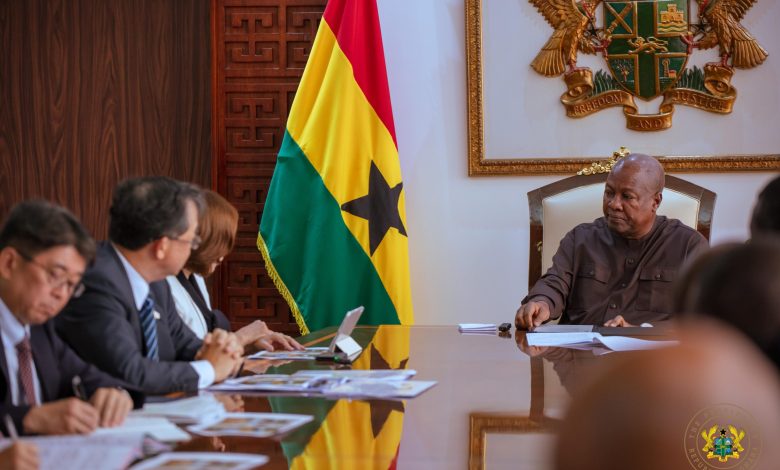
As a key part of Ghana’s Eastern Corridor road project, Japan has reiterated to President John Mahama its strong interest in funding the building of the Volta Lake bridge at Volivo.
This pledge was made by Japan International Cooperation Agency (JICA) Senior Executive Vice President Miyazaki Katsura during a courtesy call with President Mahama on Tuesday.
The proposed Volivo bridge, which will complete the vital Eastern Corridor road, is a key project under President Mahama’s $10 billion “Big Push” initiative aimed at significantly upgrading Ghana’s infrastructure.
Outlined in the 2025 budget, the Big Push plans to invest $2 billion annually over the next five years in critical sectors such as roads, bridges, education, and healthcare.
“We are happy that the Volivo Bridge project is captured under the Big Push initiative,” Katsura said, assuring President Mahama of JICA’s dedication to facilitating further discussions with the Japanese government. He also mentioned that a technical team would be sent to Ghana to evaluate the additional funding needed for the project.
President Mahama had secured Japan’s initial confirmation to fund the project during a visit to Tokyo in his previous term.
Additionally, the president accepted an invitation to the 9th Tokyo International Conference on African Development (TICAD) scheduled for August, where he plans to engage with the Japanese government to secure the necessary funding for the bridge’s construction.
Read Also
Ghana Projected To Be Among Least Affected Economies By US Tariffs
Issues with Volta Lake Water Levels
Volta Lake is currently experiencing a decrease in water levels due to global warming, which adversely affects power generation. Additionally, there is a need for a new bridge at Volivo — a crucial component of Ghana’s Eastern Corridor project — for which Japan has expressed strong support.
Meanwhile, the Adomi Bridge, a suspension bridge over Volta Lake, has recently undergone major rehabilitation works, including the replacement of the bridge deck, and is now open to traffic.
The Adomi Bridge (originally called the Volta Bridge) is a latticed steel arch suspension bridge crossing the Volta River in Atimpoku, Ghana, West Africa. The Volta Lake bridge was the first permanent bridge to span the Volta River, which drains into the Gulf of Guinea, and is Ghana’s longest suspension bridge. The bridge provides the main road link just south of the Akosombo Dam between the Eastern and Volta regions of Ghana. It was opened in 1957 by Ghana’s first president, Kwame Nkrumah.
The iconic crescent-shaped arch bridge is featured on Ghanaian stamps and currency.
About the Volta Lake Bridge
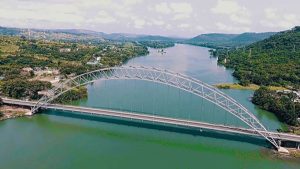
The bridge was officially opened on January 25, 1957, when Kwame Nkrumah was Prime Minister of the Gold Coast and the first President of Ghana. It carries National Route N2 and has been of tremendous help to travelers and traders accessing the eastern and northern regions of Ghana.
Volta Lake spans over 8,000 sq km and is more than 70 meters deep, making it one of the largest man-made reservoirs in the world. The bridge is being constructed downstream of the Akosombo Dam across Lake Volta, where the lake is approximately 300 meters wide.
The new Volta Bridge consists of five spans of 60 meters each and will become the longest railway bridge in Ghana. Its superstructure is made of 60-meter steel girders, the longest in the country’s infrastructure history.
Afcon’s Project On Volta Lake Bridge
Afcons Infrastructure Limited, an Indian multinational construction and engineering company, assembled a special team to design and execute this deep-profile bridge.
Afcons is working on the bridge’s construction. Specialized equipment has been deployed for critical activities, including a 1,000 MT capacity steel barge (using approximately 350 MT of structural steel), designed and fabricated in-house with necessary certifications from the Volta River Authority and maritime authorities. Reverse Circulation Drilling (RCD), vibro hammers, 260 MT and 150 MT cranes, and tugboats from various countries have been brought in to install 30 straight and raker piles.
The original Volta Lake bridge design included only straight piles. However, after careful consideration, Afcons proposed using 1.6-meter diameter raker concrete piles, which proved to be more suitable and cost-effective given the site conditions. The current design features vertical piles at the abutments and raker piles at all pier locations. This approach is a first in Afcons’s history, marking a significant milestone in their Extreme Engineering achievements.
Driving steel liners into the riverbed, which exceeds 35 meters in depth at the deepest pile location—where the overburden itself is around 35 meters thick—presented serious challenges, including frequent collapses. Additionally, the Reverse Circulation Drilling (RCD) rig had to be repeatedly assembled and dismantled for each pile due to unexpected stability issues and overburden collapses.
The Volta Bridge is one of Ghana’s most critical infrastructure projects. This challenging section of the railway project is expected to enhance transportation and stimulate numerous other developments. The socio-economic impact is substantial, with the potential to transform the region and the entire nation. Recently, the Indian High Commissioner to Ghana witnessed the laying of a raker pile foundation and publicly praised Afcons for their innovative construction technology on social media.



This is good news
That’s Amazing