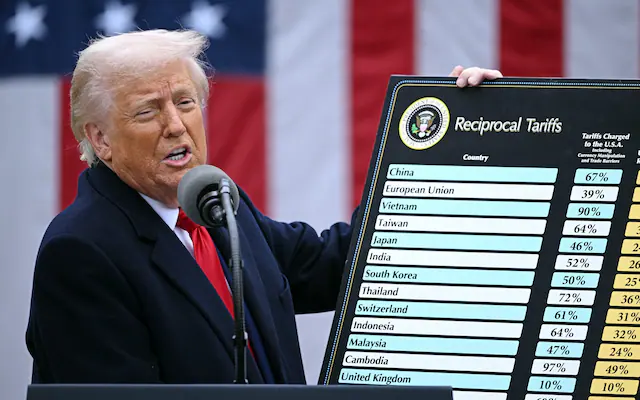
A US federal court on Wednesday ruled that President Donald Trump exceeded his authority in imposing a broad range of tariffs, a decision that could significantly alter the cost of imports for businesses and consumers across the United States. However, the administration swiftly appealed the ruling the same night, creating uncertainty for the future of these import duties and potentially prolonging a legal battle with global economic implications.
A three-judge panel at the U.S. Court of International Trade in Manhattan issued a permanent injunction against several of Trump’s global tariffs, including the “Liberation Day” tariffs announced on April 2 and those imposed earlier this year against China, Mexico, and Canada, which were intended to combat fentanyl trafficking. The court’s decision, which came in response to a lawsuit filed by the Liberty Justice Center on behalf of small businesses, gives the administration 10 calendar days to implement the permanent injunction. If the ruling stands through the appeals process and potentially the Supreme Court, it would halt the bulk of Trump’s tariffs.
Specifically, the order stops Trump’s 30% tariffs on China, 25% tariffs on certain goods from Mexico and Canada, and the 10% universal tariffs on most goods entering the United States. It does not, however, impact the 25% tariffs on autos, auto parts, steel, or aluminum, as these were levied under Section 232 of the Trade Expansion Act, a different legal authority than the International Emergency Economic Powers Act (IEEPA) that Trump cited for his broader trade actions.
Following the ruling, stock futures surged, with Dow futures rising nearly 500 points (1.1%), S&P 500 futures up 1.4%, and Nasdaq futures 1.6% higher in after-hours trading.
Legal Challenge and Court’s Rationale
The lawsuit was initiated in April by the libertarian legal advocacy group Liberty Justice Center, representing wine-seller VOS Selections and four other small businesses that claimed severe harm from the tariffs. The panel reached a unanimous decision, also ruling in favor of twelve Democratic states that had brought a separate suit against the Trump tariffs.
“We won – the state of Oregon and state plaintiffs also won,” said Ilya Somin, a law professor at Scalia Law School, George Mason University, and plaintiff lawyer, after the ruling. “The opinion rules that entire system of liberation day and other IEEPA (International Emergency Economic Powers Act) tariffs is illegal and barred by permanent injunction.”
The court’s decision hinged on the interpretation of the IEEPA, which grants the president authority to act in response to unusual and extraordinary threats but does not explicitly mention tariffs as a permissible action. The plaintiffs had argued that the Trump administration had not met the criteria for an emergency under IEEPA and that the act does not empower the president to enact tariffs. Even if it did, they contended, such an interpretation would constitute an unconstitutional delegation of Congress’s power to impose tariffs.
The court concurred, stating in its order: “IEEPA does not authorize any of the worldwide, retaliatory, or trafficking tariff orders. The worldwide and retaliatory tariff orders exceed any authority granted to the President by IEEPA to regulate importation by means of tariffs. The trafficking tariffs fail because they do not deal with the threats set forth in those orders.”
Administration’s Reaction and Potential Impact
White House spokesperson Kush Desai criticized the ruling, stating, “It is not for unelected judges to decide how to properly address a national emergency.” Stephen Miller, White House deputy chief of staff for policy, further expressed his disapproval on X, calling it “The judicial coup is out of control.”
Gary Clyde Hufbauer, a nonresident senior fellow at the Peterson Institute for International Economics, described the decision as “surprising and spectacular.” He noted that past challenges to presidential use of extraordinary authority in similar cases have typically resulted in government victories.
The ruling could offer significant relief to small businesses, many of which have struggled with increased import costs due to the tariffs. Joe Brusuelas, RSM US chief economist, suggested that if the ruling holds, it could be a “significant policy pivot point” for the economy and for members of Congress who oppose current trade policy, particularly benefiting small and medium-sized firms that lack the margins to absorb sustained tariffs.
Jeffrey Schwab, lead attorney for the Liberty Justice Center, expressed hope that the appellate court would uphold the decision, providing certainty for businesses. “He can’t just assert unlimited authority to tariff whenever he wants,” Schwab emphasized, highlighting the broader implications of the case regarding executive power.
Department of Justice lawyers had argued that the tariffs were a political question beyond the purview of the courts. However, the plaintiffs countered that IEEPA’s silence on tariffs undermined this argument.
Other Democratic States Sue Trump Over Trade Tariffs
Separately, twelve Democratic states had also sued the administration in the same court, making similar arguments about the “illegally imposing” of tax hikes through tariffs. “This ruling reaffirms that our laws matter, and that trade decisions can’t be made on the president’s whim,” said Oregon Attorney General Dan Rayfield.
The three judges on the Manhattan panel were appointed by different presidents: Judge Jane Restani by Ronald Reagan, Judge Gary Katzmann by Barack Obama, and Judge Timothy Reif by Donald Trump. The case is expected to move to the federal circuit court, with the potential to reach the Supreme Court. The U.S. Court of International Trade is a federal court in Manhattan that handles disputes related to customs and international trade laws.
Related Stories
Cedi Gaining Momentum On Global Market & Issues Arising
Trump Imposes Tariffs On Global Trade, Ghana Hit With 10%


