
- This event has passed.
It’s Time!!! Get Ready For The Ada Asafotufiami Festival 2025
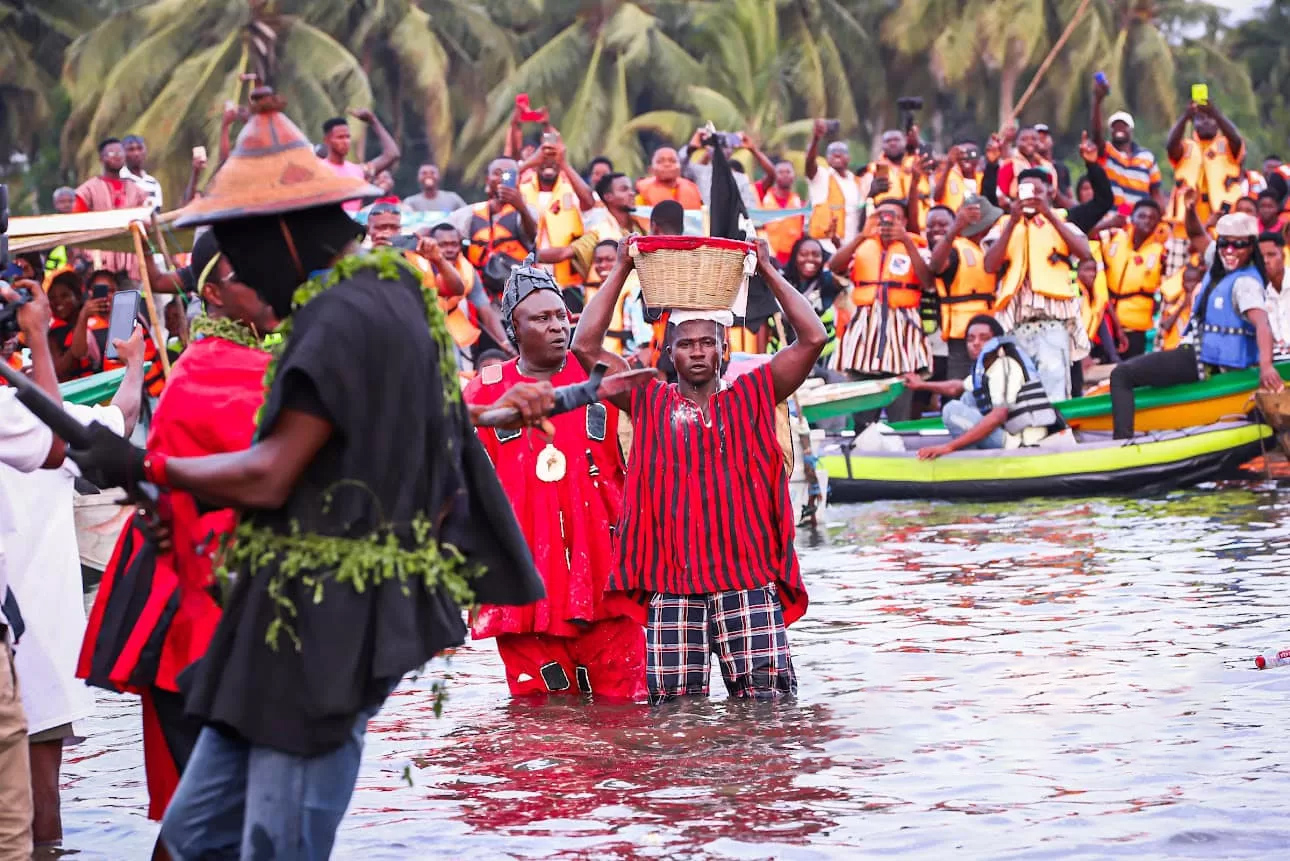
It’s that time again! Get ready for the Firing of Musketry Festival, Ada Asafotufiami. This year’s edition promises to be HUGE! 
 Expect a vibrant mix of culture, tradition, and pure Ada energy, all blended with the unique sounds of AfrocentricVibes and Uncharted Vibes. Head down to Ada, in the Greater Accra Region of Ghana
  for an unforgettable experience!
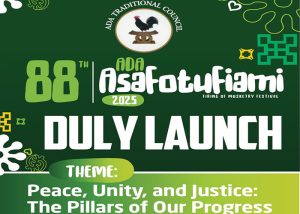
The 88th Ada Asafotufiami Festival was officially launched on June 13, 2025, with a strong call for peace, justice, and unity to remain the cornerstones of Ada’s future development.
All the festivities will take place in Big-Ada, their historical home. Make time to join the people of Ada in celebrating this year’s festival and learn more about their rich way of life. The Asafotufiami Festival is a time to remember and honor the achievements of ancestors who fought bravely in wars to secure the settlement of their people.
ACTIVITIES
- Penultimate Day
- Candle Night Procession
- Homecoming/float (Soobi-Soobi)
- Visit to The Sacred Forest (Aplaneaye)
- Music Concert (by Onua TV)
- Asafotu Gala
- Boat Racing
- Durbar of chiefs
- Cultural Expo.
- Business and Youth Forums
- Tug Of Peace. and many more…
The Ada Traditional Council Hall buzzed with anticipation as Nene Agudey Obichere III, Chairman of the Asafotufiami Planning Committee, officially launched this year’s festival. Nene Obichere called on the people of Ada to reflect on their rich heritage and embrace the enduring values that have sustained them for generations.
He emphasized that the launch wasn’t just the beginning of another celebration, but a profound moment to acknowledge the deep-rooted principles that bind the Ada people. “Peace, justice, and unity are not just ideals,” he stated passionately, “They are the living, breathing pillars of Ada’s progress.”
Nene Obichere also reminded the gathering that the festival honors the immense sacrifices of their ancestors, who bravely fought in historic battles like Torjuenya, Adidome, and Kantamanso. “Our forefathers fought for a homeland where the Volta River meets the sea. Their courage and unity brought us here,” he remarked.
Nene Obichere urged residents to embody the festival’s theme daily: “Let us be peacemakers at home, on our farms, and in our workplaces. Let us demand fairness and openness in our governance systems, and above all, let us stay united—no matter our clan or where we come from.” He encouraged all clans – Adi, Lomo, Korley, Okumo, Kabu, Agudey, and Ofoe – to see themselves as one people: Adali, and extended a warm welcome to those from Accra, Nungua, and the diaspora.
Festival Highlights & Safeguarding the Brand
Nene Obichere then outlined the key activities for this year’s festival, which runs from August 1st to 8th, 2025. The packed schedule includes traditional rites, candlelight processions, the vibrant “Soobi-Soobi” homecoming float, a visit to Aplaneaye, a grand durbar of chiefs, a cultural expo, and a music concert supported by Onua TV. The festival will also feature dedicated business and youth forums focusing on entrepreneurship and investment.
However, Nene Obichere issued a stern warning against the misuse of the Asafotufiami brand. “We welcome genuine partnerships, but we will not tolerate ambush marketing or unauthorized use of our festival’s name,” he declared, adding that a task force, in partnership with the District Assembly, will be formed to strictly monitor and enforce this.
Closing his remarks, Nene Obichere urged everyone to rise as ambassadors of peace, advocates for justice, and champions of unity. “Let our laughter echo across the estuary. Let our prayers rise like the morning mist. Let our united footsteps resound from Treasure Island through Heartland to every corner of our homeland,” he concluded, inspiring a collective sense of purpose.
Brief History of Ada
The Ada State historically encompassed a much larger territory than it does today, including the present-day Ada East and Ada West Districts. It also extended to the states of Agave, Sokpoe, Tefle, Mepe, Mafi, Bakpa, and Battor. The divisional chiefs of these states traditionally supported the Paramount Chief of Ada, who served as the overlord. However, in 1954, these latter states seceded to form what is now known as the Tongu State.
Due to this separation, new positions for Divisional Chiefs (Wetsoyihi) were created within Ada’s ten clans: Adibiawe, Ohuewem, Kabiawetsu, Lomobiawe, Korgbor, Kabiaweyumu, Terkpebiawe, Kudzragbe, Kpono, and Dangmebiawe. These Wetsoyihi, along with their respective Wornorhi (Traditional Priests) and Asafoatseme (Clan Warlords), now collectively support the paramount stool of Ada.
The Asafotufiami Festival
The Asafotufiami Festival is a vibrant cultural cornerstone of the people of the Ada Traditional Area, located in the Dangme East district of the Greater Accra Region. Celebrated annually in the first week of August, this rich heritage event commemorates the significant achievements of their ancestors in the wars fought to secure their settlements. The very name “ASAFOTUFIAMI” speaks to its essence: ASAFO meaning ‘group,’ TU meaning ‘musket,’ and FIAMI meaning ‘firing.’ Together, it literally translates to “group firing of musketry,” a powerful symbol of their martial history.
The Ada people have a storied history of engagement in various ancient conflicts, including:
- Ada-Anlo War (1844): Supported by Akwapim, Akim Abuakwa, Krobo, and Agave, the Adas decisively defeated the Anlo.
- Unsuccessful Invasion of Anlo: Ada, along with Akim Abuakwa, Akwapim, Krobo, and a portion of Mefi, attempted to invade Anlo, which was supported by Akwamu.
- Burning of Ada Township: During one conflict, the Ada township was attacked and burned by the Anlo.
- Kantamanso War: Near Dodowa, the Adas participated in the defeat of the Ashantis.
- Glover War: Captain Glover led forces from Ga, Ada, Krobo, Krepi, and Akwapim against the Anlo (who were supported by Avonos and Mafi), resulting in the Anlo’s defeat in battles near Adidome, Aveno, and Wheta.
Week-long Celebration And Regular Activity Lineups
The Asafotufiami Festival traditionally kicks off on a Thursday in the first week of August, drawing sons and daughters of Ada, well-wishers, and guests from far and wide. This opening day is dedicated to a house cleaning ceremony, pouring libations at family shrines, and keeping vigil, setting a reverent tone for the festivities ahead.
Within the Ada State, there are two traditional Asafo (groups): Akomfode and Asorkor. Membership in these groups is determined by matrilineal lineage. This unique custom often means that children of the same father but different mothers might find themselves in opposing Asafo, a fact that gives rise to the Ada people’s appellation, “Nyeko Bi, Tseko Bi” (meaning ‘mother’s child, father’s child’).
Friday: Initiation and Triumphant Return
On Friday dawn, the two Asafo groups beat their drums to summon their members for a march to Luhuese, on the outskirts of Big-Ada. Here, in accordance with ancient custom, all young men who have reached puberty are initiated into their respective Asafo. They receive their first lessons in handling, loading, and firing a musket, followed by instruction in traditional war formations and ancient battle tactics.
This rigorous training continues until late afternoon. Then, the groups make a triumphant return to Big-Ada, dressed in traditional military attire and adorned with leaves and palm branches, symbolizing conquering heroes returning from war. Their procession is accompanied by continuous musket fire and rhythmic chanting: “Awe-e-e-e – Agba e, Bleku Tso – Nsu, O, Nsu -Enam O, Enam Enam O, Enam, Manye O, Manye – Adubani Kpotoo…”
Singing, musket firing, and dancing fill the air until sunset. The procession then moves to Kpomkpo Panya, where the Asafo groups form a single file along the riverside. Here, they fire three consecutive volleys into the river, then dip their feet and wash their hands. This symbolic act is believed to wash away the evil and bad omens of the past year, ushering in good fortune for the year to come. All followers of the Asafo adhere to this custom.
After this purification, the procession disperses, and everyone retires home, with songs of jubilation echoing late into the night. The newly initiated young men, accompanied by their friends, visit the homes of their in-laws to pay homage by firing their muskets thrice. This act is met with cheers and congratulations, followed by drinks and refreshments provided by the in-laws and household. The day concludes with feasting on traditional meals and lively celebrations.
Saturday: Grand Durbar and Allegiance
Saturday is reserved for the grand durbar of the Paramount Chief, Divisional Chiefs, and Asafoatseme. Carried in their palanquins through the town, they make their way to the Big-Ada Presbyterian Junior Secondary School Park, where elders, men, women, and children, all dressed in their finest, eagerly await their arrival.
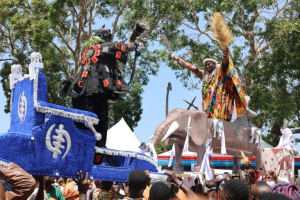
Youth groups from Ada and various charitable societies established in other towns, identifiable by their uniforms, also parade through the streets of Big-Ada to the durbar grounds. They march past and take their positions, gracing the occasion with patriotic and melodious songs for the Saturday and Sunday events.
The Paramount Chief formally greets the Divisional Chiefs, Asafoatseme, Elders, and the assembled people before sitting in state to receive their homage in return. A significant moment is the swearing of allegiance by the Asafoatseme, each oath sealed with a volley of musketry from their divisions. This swearing of allegiance to the Paramount Chief includes recounting the ancient wars in which the Adas bravely fought.
As the day’s events draw to a close, the Paramount Chief, divisional chiefs, Asafoatseme, elders, and the people return home, accompanied by youth associations and benevolent societies, amidst songs, drumming, and jubilation. Evenings are filled with cinema shows and grand ball dances.
Sunday and Beyond: Thanksgiving and Modern Additions
Sunday brings a non-denominational open-air church service at the durbar venue, a time for giving praise and thanks to Almighty God for abundant blessings and the festival’s success.
The following weekdays, Monday through Thursday, are packed with lively activities: boat racing, tug-of-war, get-togethers for the elderly, river excursions, and football matches. Individuals also exchange goodbyes, cherishing happy memories of the year.
Historically, the Asafotufiami Festival was temporarily discontinued due to World War I. To encourage Ada’s sons and daughters residing elsewhere to return home and contribute to the development of the Ada State, the Ada Pastors and Teachers Association (APTA) collaborated with the Ada National Improvement Association (ANIA). They proposed the festival’s revival to the chiefs and elders, receiving overwhelming support. Thus, the ancient “Asafotu” Festival was gloriously reborn in 1937.
Modern additions to the festival include the symbolic fetching of water with baskets at Kpomkpo Panya in Big-Ada, and the marching of the Asafoatseme and their troops to “A plɛ nɛ α hiɛ,” a place in the Big-Ada courtyard also known as “Nga noɔ yami.”
IT IS TIME FOR ADA ASAFOTUFIAM, DON’T MISS OUT!!!
LONG LIVE ADA! LONG LIVE ASAFOTUFIAMI! LONG LIVE GHANA ! OKLIBONE!
Related Articles
Ghana Dance Association Announces “Door of Return” U.S. Tour for 2025