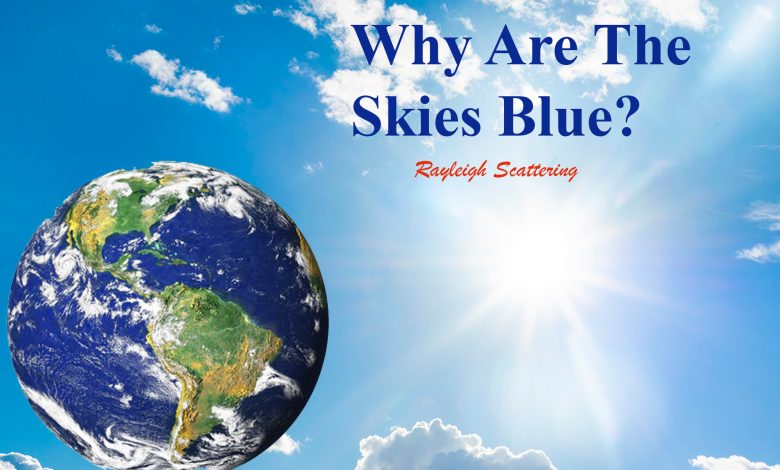
In Ghana, people frequently ask, “Why are the skies blue?” When asked, some people usually find it amusing and assume it is usual, while others think it is simply natural or something that must be the case. Few attempt to provide concrete answers, while others find ways to run from the question. There is actually a science behind it and that is what we will explore today, so that the next time you meet the question, you won’t run away.
A Spectrum of Colors Form Sunlight
To understand why the sky appears blue, we must first appreciate the composition of sunlight. Sunlight is made up of a continuous spectrum of colors, separated into three major components, namely; Visible Light/Spectrum(Rainbow), Ultraviolet Light/Spectrum, and Infrared Radiation. The visible spectrum which appears to our eyes as white light is actually a mixture of all the colors of the rainbow – red, orange, yellow, green, blue, indigo, and violet. The Ultraviolet Light and the Infrared Radiation cannot be seen with the bare human eyes because they have extremely shorter and extremely longer wavelength respectively than the eyes can see.
A Quick Visit To The Idea Of Wavelength
Wavelength describes the distance between two consecutive, identical points on a wave, such as from one crest (peak) to the next crest, or one trough (low point) to the next trough. It’s a fundamental property of all wave phenomena, including light, and is often denoted by the Greek letter lambda ().
Considering the rainbow (visible spectrum) and the ultraviolet (UV) spectrum, wavelength plays a crucial role in distinguishing the different types of light we see (or don’t, in the case of UV).
-
Rainbow (Visible Spectrum): This is the narrow band of the electromagnetic spectrum that our eyes can see. Different colors within the rainbow correspond to different wavelengths of visible light.
- Red light has the longest wavelengths (around 700 nanometers).
- As we move through orange, yellow, green, blue, indigo, and finally violet light, the wavelengths progressively get shorter (down to around 400 nanometers). This means that red light has the longest wavelength, while violet light has the shortest.
-
Ultraviolet (UV) Spectrum: This lies beyond the violet end of the visible spectrum and has even shorter wavelengths (ranging from approximately 10 to 400 nanometers). Because their wavelengths are shorter than what our eyes are sensitive to, we cannot see UV light.
Sunlight Scatters In The Earth’s Atmosphere
The Earth is enveloped by a blanket of gases, collectively known as the atmosphere. This atmosphere is primarily composed of nitrogen (about 78%) and oxygen (about 21%), with trace amounts of other gases, water vapor, and tiny particles like dust and pollutants. It is these atmospheric components, particularly the nitrogen and oxygen molecules, that play a crucial role in the sky’s blue hue.
Rayleigh Scattering: The Key Phenomenon
The reason the sky is blue lies in a phenomenon called Rayleigh scattering, named after the British physicist Lord Rayleigh, who first explained it in the late 19th century. Rayleigh scattering describes the scattering of electromagnetic radiation (including visible light) by particles of a much smaller wavelength.
When the sunlight enters the Earth’s atmosphere, it collides with these tiny air molecules – primarily nitrogen and oxygen. These molecules absorb some of the sunlight and then re-emit it in different directions. This re-emission is what we perceive as scattered light.
Here’s the crucial part: the amount of scattering is inversely proportional to the fourth power of the wavelength of light. Written as;
Intensity of scattered light (I) = 1/λ⁴
This means that shorter wavelengths of light are scattered much more strongly than longer wavelengths.
Consider the colors of sunlight again. Violet and blue light have the shortest wavelengths in the visible spectrum. Therefore, they are scattered by the air molecules much more effectively than the longer wavelengths of red and orange light. Green light is scattered more than yellow and red, but less than blue and violet.
Why Blue and Not Violet?
If violet light is scattered even more than blue light, why does the sky appear predominantly blue to our eyes? There are a couple of reasons for this:
- Sunlight’s Intensity: While the sun emits all colors of the rainbow, the intensity of violet light in sunlight is slightly less than that of blue light.
- Our Eyes’ Sensitivity: Also, our eyes are more sensitive to blue light than to violet light. The cones in our retinas that are responsible for color vision are more responsive to the wavelengths associated with blue.
- Moreover, blue is scattered more than other colors because it travels as shorter, smaller waves.
As a result of these factors, the scattered light that reaches our eyes is predominantly blue, giving the sky its characteristic color on a clear day.
Role Of Rayleigh Scattering In The Redness of Sunrises and Sunsets

The phenomenon of Rayleigh scattering also explains the beautiful red and orange hues we often see during sunrises and sunsets.
When the sun is low on the horizon, sunlight has to travel through a much greater distance of the Earth’s atmosphere to reach our eyes compared to when the sun is directly overhead. As the sunlight travels through this longer path, most of the shorter wavelengths (blue and violet) are scattered away in different directions.
By the time the sunlight reaches our eyes, the longer wavelengths – red and orange – are the ones that have managed to penetrate through the atmosphere without being scattered as much. This is why the sun and the sky around it appear reddish or orange during sunrise and sunset.
Variations in Sky Color
While blue is the most common color we associate with the sky, its appearance can vary depending on several factors:
- Haze and Pollution: The presence of larger particles like dust, pollutants, and water droplets in the atmosphere can scatter all wavelengths of light more equally. This type of scattering, known as Mie scattering, results in a whiter or grayer sky.
- Clouds: Clouds are composed of water droplets or ice crystals that are much larger than air molecules. They scatter all wavelengths of visible light effectively, which is why clouds appear white. Darker clouds contain larger and denser water droplets or ice crystals, which absorb more light, making them appear gray or black.
- Night Sky: At night, when there is no direct sunlight to be scattered, the sky appears black, punctuated by the light of stars and other celestial bodies. Away from city lights, the faint glow of the moonlit sky can sometimes have a slightly bluish tint due to the scattering of moonlight by the atmosphere, albeit much less intense than during the day.
- Time of day: During sunrise and sunset, the light travels through more of the atmosphere, scattering shorter wavelengths and making the sky appear more red.
- Altitude and atmospheric pressure: The sky can appear more intense blue at higher altitudes due to lower air pressure.
Not All Skies Are Blue
The color of the sky on other planets and moons depends on the composition and density of their atmospheres (if they have one). For example, Mars has a very thin atmosphere primarily composed of carbon dioxide. Dust storms on Mars can scatter reddish light, giving the Martian sky a butterscotch hue during the day and blue around the sun at sunset.
Simplified Explanation On Why The Skies Are Blue
- Sunlight enters Earth’s atmosphere and is made up of a spectrum of colors (wavelengths).
- The smaller molecules of gases like nitrogen (N2) and oxygen (O2) scatter the shorter wavelengths (blue and violet) in all directions.
- Our eyes see the scattered blue light coming from all parts of the sky, making it appear blue.
- The longer wavelengths (red, orange, and yellow) continue to travel in a straight line, reaching our eyes from a more direct path, which is why we see the sun itself as yellowish.
Conclusion
Now, next time you gaze up at a blue sky, remember the tiny molecules of gases and the scattering of light that makes it all possible! And don’t run away from the question when you are asked next time.
Continue Reading
Life Outside Earth: Do Aliens Exist?


