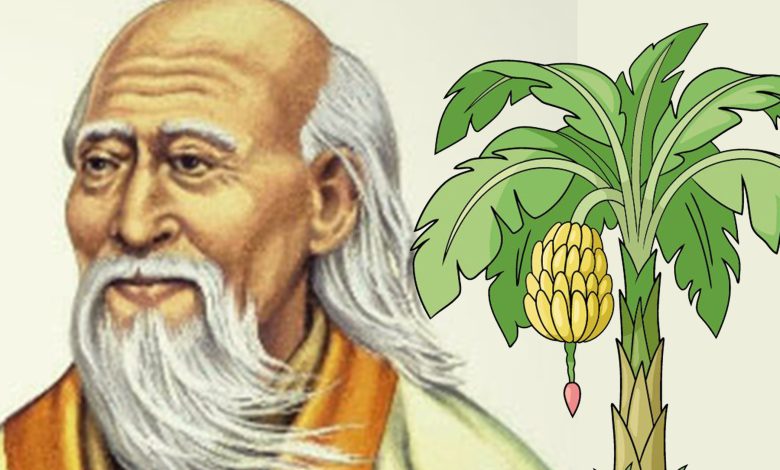
For ages, banana has been called “the fruit of wise men,” and in this article, we’ll explore why. What makes bananas so special? Why are they considered the fruit of wise men among all other fruits?
The banana’s association with wisdom stems from ancient India, where sages, or “rishis,” were said to have rested under banana plants and enjoyed their fruit. This imagery, passed down through time, has given the banana its symbolic title.
According to the old story, these revered figures, known for their wisdom, knowledge, and spiritual insight, would gather beneath the shade of banana plants. The banana’s connection to wisdom is further cemented by its botanical name, Musa sapientum, which translates to “fruit of wise men.”
Carolus Linnaeus, a Swedish biologist who formalized the modern system of naming organisms (binomial nomenclature), bestowed this Latin name upon the banana after learning of the story of Indian sages enjoying the fruit. Linnaeus used Latin, the common language of science at the time, to ensure international communication among scholars.
He combined Musa (meaning “Muse,” a source of artistic inspiration) and sapientum (meaning “of the wise”) to create the name. In 1750, Linnaeus also gave plantains the name Musa paradisiaca, meaning “heavenly fruit” or the forbidden fruit of paradise. Belonging to the Musa genus, this elongated, curved fruit – technically a berry – boasts a rich history, an impressive nutritional profile, and a surprising array of health benefits. From infants to athletes, the banana holds a special place in diets worldwide.
Origins in Southeast Asia:
The earliest evidence suggests that wild bananas originated in the region encompassing present-day Papua New Guinea and Southeast Asia, possibly including the Malay Peninsula, Indonesia, and the Philippines, as far back as 10,000 years ago. Some scientists even believe bananas might have been among the first fruits to be domesticated. These wild bananas were quite different from the sweet, seedless fruit we know today. They were smaller and contained many large, hard seeds with very little edible pulp.
Early Domestication:
Around 7,000 years ago, the first steps towards domestication likely occurred in Papua New Guinea. Early agriculturalists would have selected and cultivated naturally occurring mutant varieties that produced larger, fewer-seeded, and more palatable fruit. These early cultivated bananas were likely propagated using suckers (shoots that grow from the base of the plant) since the edible varieties were often seedless.
Spread Across Asia and Beyond:
From their likely origins in New Guinea, bananas gradually spread across Southeast Asia. Evidence suggests they reached: India, China, Africa and Middle East.
Bananas were introduced to the Americas much later, after the European voyages of discovery. Portuguese sailors are credited with taking bananas from West Africa to the Canary Islands in the 15th century. From there, they were brought to the New World, likely first to Hispaniola (now Haiti and the Dominican Republic) in the early 16th century. They then spread to other Caribbean islands and the mainland of Central and South America.
The banana we predominantly consume today is the Cavendish variety. It rose to prominence in the mid-20th century after the Gros Michel, the previously dominant variety, was decimated by Panama disease. The Cavendish was more resistant to this disease and had good shipping qualities.
Fun Facts About Bananas:
- Botanically, bananas are berries.
- Bananas float in water because they are less dense than water.
- India is the largest producer of bananas in the world, although a significant portion is consumed domestically.
- Banana peels can be used for various purposes, including polishing leather shoes, fertilizing plants, and even as a natural remedy for insect bites.
- There are over 1,000 varieties of bananas grown worldwide, though only a few are widely exported.
- The “threads” you peel off a banana are called phloem bundles.
- Eating bananas can help alleviate muscle cramps, often attributed to their potassium and magnesium content.
Other Facts To Explore
Poor Sleep Can Kill You Faster Than Starvation, This Is Why
The banana plant, often mistaken for a tree, is actually the world’s largest herbaceous flowering plant. What we commonly refer to as the “fruit” are seedless cultivars that have been developed over centuries. These fleshy fruits grow in hanging clusters, known as hands, which together form a larger bunch. The most widely consumed variety is the Cavendish, known for its sweet flavor, yellow peel when ripe, and easy transportability. However, numerous other varieties exist, each with its unique taste, texture, and size.