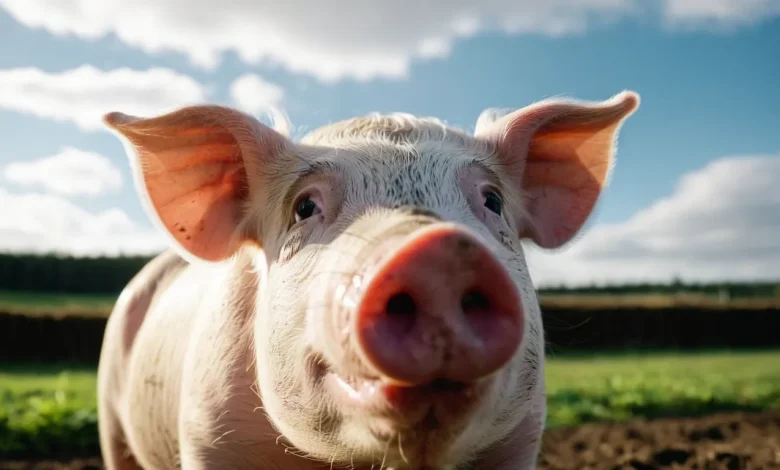
Pigs are intelligent and often misunderstood creatures are deeply connected to the earth, with their daily routines revolving around foraging, wallowing, and social interactions within their immediate surroundings.
Unlike humans and many other mammals with a wide range of head and neck mobility, pigs possess a unique musculoskeletal structure that severely limits their upward gaze. This isn’t due to a lack of curiosity, but rather a consequence of their evolutionary path and the specific adaptations that have allowed them to thrive in their terrestrial niche. To truly understand why a pig’s view is so firmly fixed on the ground, we need to delve into the intricacies of their neck and head anatomy.
The Role of Cervical Vertebrae & Rigid Neck Structure
The primary limiting factor lies in the fusion of the cervical vertebrae, the bones that make up the neck. While humans have seven distinct cervical vertebrae allowing for a considerable degree of flexion, extension, and rotation, pigs exhibit a significant degree of fusion in these bones. This fusion creates a much more rigid neck structure, providing stability for their powerful snout and head, which are essential tools for rooting and digging. This robust structure, however, comes at the cost of flexibility, particularly when it comes to extending the head upwards.
Imagine trying to lift your head and look directly at the ceiling while keeping your neck completely stiff. This is the inherent challenge faced by a pig. The fused vertebrae act as a solid block, preventing the necessary articulation that would allow for significant upward movement.
Musculature and Head Structure
Furthermore, the musculature surrounding the pig’s neck and head is also adapted for downward and lateral movements rather than upward extension. Powerful muscles are responsible for driving the snout into the ground, enabling them to unearth roots, tubers, and other food sources. These muscles are anchored in a way that facilitates a strong downward thrust, but they lack the leverage and arrangement required for a substantial upward lift of the head.
The shape and positioning of the pig’s skull also contribute to their limited upward vision. Their elongated snout and the placement of their eyes, which are typically positioned laterally rather than frontally, provide them with a wide panoramic view of their surroundings, crucial for detecting predators and locating food at ground level. However, this lateral placement, combined with the bony structure of the skull, restricts their ability to focus their gaze directly upwards.
Think of it this way: the brow ridge and the overall shape of their skull act as a natural visor, further obstructing their upward field of vision. To see something directly above them, a pig would need to tilt its entire head back significantly, a movement that is severely hampered by their fused cervical vertebrae and the arrangement of their neck muscles.
Implications for Behavior Of The Pig
While it is widely believed that pigs can’t look up into the sky, it’s important to clarify that they aren’t entirely incapable of any upward movement. They can likely lift their heads slightly and perceive objects in their upper peripheral vision. However, achieving a direct, sustained gaze at the sky, as a human can, is physically impossible for them due to their anatomical constraints.
This limitation in their field of vision has interesting implications for their behavior and their interaction with the world. As ground-dwelling creatures, their primary focus is on what lies beneath and around them. Their keen sense of smell, coupled with their ability to effectively navigate their environment with their limited vertical vision, makes them highly successful foragers. They rely on their acute senses of smell and hearing to detect potential threats from above, rather than visual scanning of the sky.
Consider a pig in a pasture. Its attention is typically directed towards the ground, rooting for food or interacting with other pigs. While a bird flying overhead might register in their peripheral vision or through sound, they are unlikely to crane their necks upwards to follow its flight. Their world is largely horizontal, a plane of scents, textures, and the immediate landscape.
In conclusion, pigs possess a significant limitation in their ability to look upwards due to the fusion of their cervical vertebrae, the arrangement of their neck muscles, and the structure of their skull. The pig’s strong neck and downward-oriented snout are ideal for their foraging lifestyle, even if it means sacrificing the ability to admire a sunset or track the movement of clouds.
Other Facts To Explore
Why The Tiger Has A Striped Skin