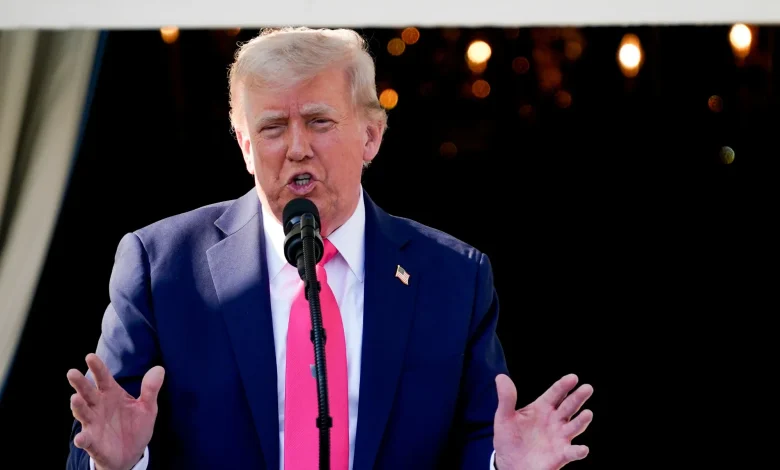
President Donald Trump has announced that the U.S. will impose additional tariffs on any nation supporting the “anti-American” policies of the BRICS group of emerging economies. This threat comes as tariff letters are being sent to numerous countries starting Monday, ahead of a critical July 9 deadline for existing tariff negotiations.
New Tariff Threats and BRICS Alignment
In a Truth Social post on Sunday, Trump declared a 10% additional tariff on “any country aligning themselves with the Anti-American policies of BRICS” with “no exceptions.” It remains unclear which specific BRICS policies Trump was referencing.
The BRICS group, originally comprising Brazil, Russia, India, China, and South Africa, advocates for a “multipolar” global order that redistributes power to reflect current economic realities, challenging a West-led world order. The group has recently expanded to include Egypt, Ethiopia, Indonesia, Iran, and the United Arab Emirates, along with ten lower-level partner countries such as Belarus, Nigeria, Thailand, and Vietnam. Saudi Arabia’s acceptance of an invitation to join is still unconfirmed.
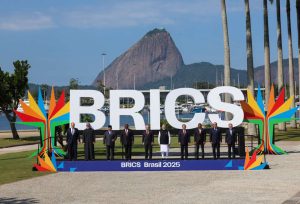
Notably, Brazil is currently hosting a BRICS summit, where leaders released a joint declaration Sunday expressing “serious concerns” about “unilateral tariff and non-tariff measures” – an apparent veiled critique of the Trump administration’s trade policies.
Read Also: US Federal Court Blocks Trump’s Sweeping Global Tariffs
Tariff Deadlines and Negotiations
The U.S. administration’s 90-day tariff pause is set to conclude on Wednesday. Trump confirmed Sunday night that letters would be dispatched to dozens of countries from Monday. “I am pleased to announce that the UNITED STATES TARIFF Letters, and/or Deals, with various Countries from around the World, will be delivered starting 12:00 P.M. (Eastern), Monday, July 7th,” he stated on Truth Social.
Treasury Secretary Scott Bessent had previously indicated that tariffs could revert to April levels if countries failed to secure deals with the U.S. “If you don’t move things along, then on August 1 you will boomerang back to your April 2 tariff level,” Bessent told CNN on Sunday.
Trump has hinted that these letters could propose duty rates at the current 10% baseline or as high as 70%. However, Bessent clarified that the U.S. would not impose 70% tariff rates on major trading partners. While Trump mentioned sending “12, maybe 15” letters related to trade deals, Bessent stated that approximately 100 letters would go out to smaller countries, many already at the 10% baseline. Trump asserted that most countries would have either a letter or a deal by July 9.
Commerce Secretary Howard Lutnick confirmed that new tariff rates would indeed go into effect on August 1. Bessent emphasized the administration’s “maximum pressure” approach, stating, “It’s not a new deadline. We are saying, ‘This is when it’s happening. If you want to speed things up, have at it. If you want to back to the old rate, that’s your choice.'” He cited the European Union as an example of countries engaging in negotiations after previous tariff threats.
So far, the Trump administration has announced deals with only three countries: the United Kingdom (10% tariff rate), China (temporarily paused duties from 145% to 30%), and Vietnam (minimum 20% tariff). Bessent noted that the upcoming letters “will set their tariff rates. So we will have 100 done in the next few days,” adding that the U.S. holds “the leverage in this situation” due to its trading deficit.
Implications for BRICS and Economic Risks
Trump’s latest threat introduces fresh instability into his global tariff campaign as the July 9 deadline for “reciprocal” tariff negotiations looms. While some BRICS countries, notably India, have been in direct negotiations with the Trump administration, it’s unclear how these new threats will impact ongoing talks. Earlier this year, Trump had also threatened “100% tariffs” on “seemingly hostile” BRICS members if they supported a shared currency, an idea that has been floated but is not a central focus of the group, which instead aims to bolster local currency trade.
On Sunday, BRICS leaders backed ongoing discussions for a cross-border payments initiative among member countries. They also condemned military strikes on member state Iran and expressed “serious concern” over “deliberate attacks on civilian infrastructure” and “peaceful” nuclear facilities, implicitly referencing recent actions by Israel and the U.S.
Economists continue to warn that Trump’s trade policies, particularly wide-ranging tariffs on Chinese imports, will increase costs for consumers. Despite pushback from Trump, companies like Walmart have indicated they will raise prices. Treasury Secretary Bessent has dismissed such warnings as “misinformation” and “tariff derangement syndrome,” arguing that countries like China would bear the cost.
Recent data shows U.S. wholesale inflation rose slightly in May, driven partly by costlier goods, though direct tariff-related effects were largely muted. The Producer Price Index increased 0.1% in May, lifting the annual rate to 2.6%. Former Treasury Secretary Larry Summers criticized Bessent, asserting that tariffs would lead to higher inflation and reduced competitiveness for American producers. However, Stephen Miran, Chairman of the White House Council of Economic Advisers, contended there was no “lasting evidence” that tariffs imposed during Trump’s first term harmed the economy, citing “tariff revenue is pouring in” and “job creation remains healthy.”
Harvard Sues Trump Administration Over International Student Ban