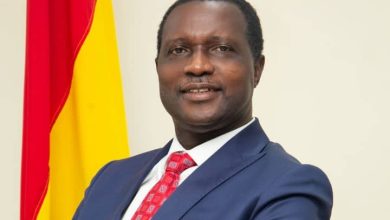
July 1 has gradually become a bone of contention in Ghana’s political landscape, typically between the two main political leaders in the country i.e.; Former and Retired President Nana Addo-Danquah Akufo-Addo of the New Patriotic Party (NPP), and current president John Dramani Mahama of the National Democratic Congress (NDC). At the end of this write up, I will leave you to judge whether the battle is worth it.
But before I proceed, let me take a pause and ask, how did we get here as a country? How did all this start? Are we gradually losing our rich history and culture? Is it a problem of leadership? Or we just don’t know what we want? Who will save us?
Citizens have become chaffs, blown by politically-motivated decisions into any direction. At this point, every Ghanaian is a victim of political victimization. It feels like national priorities are being reduced to a power struggle between two figures, with each trying to prove where the power lies. Citizens are suffering as a result of political battles. Citizens are living in limbo, as to what day is what, and what is to be celebrated.
But there is one thing I can tell for sure; our history is being altered. A nation’s foundation lies in its history – it defines who we are, where we come from, and where we’re going. Just like our individual stories, our national narrative holds immense power and should be treated with respect.
Today, July 1, 2025, would have been holiday marking the 65th celebration of Ghana’s historical Republic Day but we are all currently confused in the country. The reason? It’s simple; one “self-full” political leader cancelled it and another “self-acclaimed” savior and political leader is trying to restore it. What I see is “unchecked power” leading to “power drunkenness”.
Ghana became a Republic on July 1, 1960. Until Akufo-Addo’s presidency, we celebrated this day to commemorate the moment we started governing ourselves with our own Constitution.
It’s arguably the second most important day in our history. Independence came first, but Republic Day marked the point where we finally had “total freedom” under our own laws. So why is such a significant day being sidelined?
Read Also: NPP Flagbearership Race: Contenders & Election Date, Everything You Need To Know
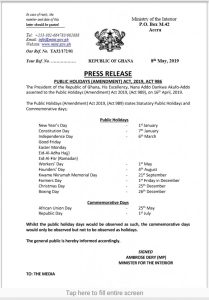
The Public Holidays (Amendment) Act 2019 (Act 986)
On April 16, 2019, former president Nana Addo Dankwa Akufo-Addo assented to the Public Holidays (Amendment) Act 2019, scrapping July 1 as the historical Republic Day and a holiday.
The Public Holidays (Amendment) Act 2019 (Act 986) altered the list of public holidays, designating specific days as either statutory public holidays or commemorative days. Key changes included the establishment of Founders’ Day on August 4th and Kwame Nkrumah Memorial Day on September 21st, while also making African Union Day (May 25th) and Republic Day (July 1st) commemorative days instead of public holidays.
- Statutory Public Holidays:
- January 7th (Constitution Day)
- August 4th (Founders’ Day)
- September 21st (Kwame Nkrumah Memorial Day)
- December 1st (Farmers’ Day)
- December 25th (Christmas Day)
- December 26th (Boxing Day)
- Commemorative Days:
- May 25th (African Union Day)
- July 1st (Republic Day)
Motivations Behind The Public Holidays (Amendment) Act 2019 (Act 986) & Scrutiny
Founders’ Day
Before the amendment, September 21, was Founders’ Day and was observed as a public holiday across the country. This date was chosen to commemorate the birth anniversary of Ghana’s first president, Kwame Nkrumah, and to recognize his role in leading the country to independence. September 21, 1909 is actually the birthday of Osagyefo Francis Kwame Nkrumah who championed the fight for Ghana’s independence and became the first president of the country. Setting the birthday of Kwame Nkrumah as Founder’s Day sparked debate over whether other contributors to Ghana’s independence were being sidelined.
However, in 2019, the holiday was moved to August 4th and renamed Founders’ Day. This change was made to honor the collective efforts of the “Big Six” members of the United Gold Coast Convention (UGCC) who are considered the founders of Ghana’s independence movement. August 4th was chosen as it marks the date the UGCC was founded in 1947.
In President Nana Akufo-Addo’s amendment, September 21 was to be observed as Kwame Nkrumah Memorial Day.
The Presidency’s statement at the time said August 4, is “obviously the most appropriate day to signify our recognition and appreciation of the collective efforts of our forebears towards the founding of a free, independent Ghana.” According to Akufo-Addo, “it is time we rose above partisan considerations, set the record straight, recognize the collective efforts in gaining our freedom and independence from colonial rule and do right by our history.”
The shift was met by criticism from across the political divide, especially groups with Nkrumaist ties.
Republic Day
Also, the then president, Akufo-Addo in the amendment cancelled the Republic Day celebration which was observed as a public holiday on July 1, shifting it to 7th January in memory of the 4th Republican Constitution. This legislation made 1st July a commemorative day and 7th January the Constitution Day. January 7 also holds special significance in election years, as it is the day on which Ghana’s Heads of State are sworn into office.
Ghana celebrates Constitution Day every January 7th, a vital occasion commemorating the 1992 Constitution’s adoption and the start of the Fourth Republic. First observed in 2019, this public holiday underscores Ghana’s deep commitment to the rule of law, constitutionalism, and democratic governance.
Ratified by a referendum on April 28, 1992, and fully implemented on January 7, 1993, the 1992 Constitution serves as the bedrock of Ghana’s political system. It meticulously outlines the government’s structure, powers, and duties, along with the fundamental rights and responsibilities of its citizens.
The introduction of Constitution Day garnered broad support from across the political landscape, including the National Democratic Congress (NDC). Peter Boamah Otokunor, then the NDC’s Deputy General Secretary, affirmed the holiday’s legitimacy, stating it was “not out of place to celebrate it as a public holiday.” While the NDC did express reservations about August 4th being designated Founders’ Day and September 21st as Kwame Nkrumah Memorial Day, there was clear consensus on the importance of recognizing Constitution Day itself.
Could this move by Akufo-Addo be a matter of national benefit or personal interest? I’ll leave you to debate that.
Significance of July 1st In Ghana’s History
Republic Day is a public holiday in Ghana, and it is also recognized as Senior Citizens’ Day, honoring the elderly who played a role in the nation’s independence and development. The day signifies Ghana’s complete liberation from colonial rule and the establishment of a sovereign, self-governing nation.
Mahama Condemns Cancellation Of July 1 Republic Day
The scrapping of the July 1 holiday was met with significant oppositions which were though disregarded by Akufo-Addo.
The Nana Akufo-Addo administration’s decision to revoke Republic Day (July 1st) as a public holiday drew strong criticism from the opposition.
John Dramani Mahama, then the main opposition leader and Flagbearer of the National Democratic Congress (NDC), lamented the change. In a message marking the day, the former President accused the administration of attempting to rewrite Ghana’s history. He emphasized in a Facebook post: “59 years ago, our beloved Ghana became a Republic and acquired true political independence from the shackles of colonialism.”
Adding to the outcry, Koku Anyidoho, formerly the NDC’s Deputy General Secretary, expressed profound disappointment. He argued that canceling Republic Day was an attempt to revise the nation’s history, which he believed would hinder progress made by previous governments and ultimately not serve the country’s best interests. “Some of these things really don’t help in the development of our country,” he stated, adding, “This decision is just like changing someone’s birthday and if someone does that, it means the person is just toying with your identity.”
Anyidoho further contended that maintaining July 1st as a holiday wouldn’t have negatively impacted the country’s development or job creation, questioning, “Mind you that all these happenings have been documented in history books. Are you going to change this history?”
Ghana’s Birthday & A National Day of Prayer
In February 2025, which was just about two (2) months after the country went to the polls on December 7, 2024, the newly elected president, John Dramani Mahama, after assuming office proposed that a National Day of Prayer and Thanksgiving should be held on July 1, which is also Ghana’s Republic Day, and marks Senior Citizens Day.
Mahama went a step further, stating that his government would be sending amendments to the Public Holidays Act to Parliament, with the goal of bringing July 1st back as a public holiday. Then, on June 24th, President Mahama officially announced that July 1st, Ghana’s Republic Day, would be reinstated as a statutory public holiday, and would also be known as the National Day of Prayer and Thanksgiving.
Speaking at the 2025 Supernatural Empowerment Summit held at the Perez Chapel in Accra on May 4th, Mahama explained the date’s spiritual and historical significance. He emphasized that it represents Ghana’s complete transition to a republic and symbolizes the real birth of the nation.
“As I’ve declared, on 1st July, which is our Republic Day—our Republic Day is actually Ghana’s birthday because in 1957, even though we became independent, we were a dominion of the British Empire,” he said. “It was on 1st July that we became a republic and cut ties with the British Empire. So on that day that the true Ghana was born, I’ve said we must give thanks to the Almighty God. And so we’re restoring the holiday to that day.”
The New Public Holidays and Commemorative Days Amendment Bill 2025
On June 25, 2025, parliament passed the new Public Holidays and Commemorative Days Amendment Bill 2025, removing the August 4 Founders’ Day holiday from the national calendar.
In its place, September 21, the birthday of Ghana’s first President, Osagyefo Dr Kwame Nkrumah, has been reinstated as the official Founders’ Day.
Announcing the changes in Parliament, Interior Minister Mohammed Muntaka Mubarak explained the rationale: “We’ve taken out the 4th of August as then been termed as Founders’ Day because we believe that as a country, we are not unanimous around it and it serves as a divisive day for us as Ghanaians. So we’ve taken that out and we have maintained the 21st September and now we term that as the Founders’ Day, which is the birthday of Osagyefo Dr. Kwame Nkrumah, the founder of our country, the one who led us into independence.”
In a notable addition, the amendment also designates July 1st as a full public holiday, marking Republic Day.
Other retained public holidays include New Year’s Day (January 1), Constitution Day (January 7), Independence Day (March 6), the two Eids, Labour Day (May 1), Good Friday, Easter Monday, Farmers’ Day (first Friday in December), Christmas (December 25), and Boxing Day (December 26).
This legislative action directly reverses the 2019 amendment by President Akufo-Addo’s administration, which had established August 4th to celebrate Ghana’s founding fathers while reclassifying September 21st as Kwame Nkrumah Memorial Day.
What’s Happening Today July 1, 2025?
Ghana observed its inaugural National Day of Prayer on today, July 1, led by President John Dramani Mahama.
This new annual event aims to foster spiritual reflection and national unity amid the country’s ongoing challenges.
The day featured interfaith services, beginning with a Christian gathering at the State House at 8:00 AM. This was followed by a Muslim prayer session at the Accra National Mosque at 12:00 PM. Both ceremonies saw public participation alongside government officials, including Vice President Jane Naana Opoku-Agyemang.
Prominent religious leaders joined the observances, underscoring the event’s cross-religious emphasis. Cardinal Peter Appiah Turkson attended the State House proceedings, while Chief Imam Dr. Sheikh Osman Nuhu Sharubutu participated in the National Mosque service.
The day’s program centered on themes of peace and moral renewal. President Mahama’s administration highlighted the importance of collective resolve during the nation’s economic recovery efforts. Organizers expressed hope that this new tradition will embed resilience within Ghanaian society. The National Democratic Congress government framed the event as non-partisan, inviting engagement from the opposition, and plans to assess its impact on national harmony in future editions.
July 4 Declared Public Holiday
The Ministry of the Interior, through Minister Mohammed-Mubarak Muntaka, has announced that Friday, July 4, 2025, will be observed as a public holiday in Ghana. This decision is to mark Republic Day, which officially falls on Tuesday, July 1, 2025.
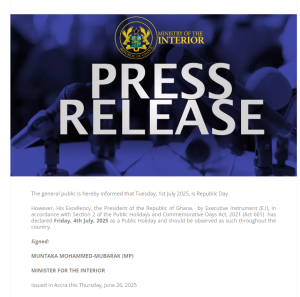
A statement from the Minister explained, “The general public is hereby informed that Tuesday, 1st July 2025, is Republic Day. However, His Excellency, the President of the Republic of Ghana, by Executive Instrument (EI), in accordance with Section 2 of the Public Holidays and Commemorative Days Act, 2021 (Act 601), has declared Friday, 4th July 2025, as a Public Holiday and should be observed as such throughout the country.”
This declaration follows Parliament’s recent approval of the Public Holidays and Commemorative Days (Amendment) Bill, 2025, which officially reinstates July 1st as Republic Day and a full public holiday.
The Big Question
The big question now is whether a future New Patriotic Party administration, if elected, will once again reverse the decisions made by the National Democratic Congress. Should this pattern of reversals continue, what does it signify for Ghana’s stability – will the nation become a mere political playground for rivals to display their political prowess? If not, what measures will be taken to safeguard the current administration’s decisions, preventing this constant back-and-forth?
But in all, let’s keep it in mind that a nation’s history is a very powerful tool. It is their story, a reflection of who they are. History cannot be rewritten, and it must never be manipulated to suit political taste!!!